Radome Size and Mounting Height: What Changes When You Go Up a Model
Buying the next model up is not only a gain decision. It is 12 to 93 kg more weight, a taller radome, and a different conversation with whoever owns the mast.
- Author
- TVROVSAT Marine Engineering
- Date
- Read
- 6 min
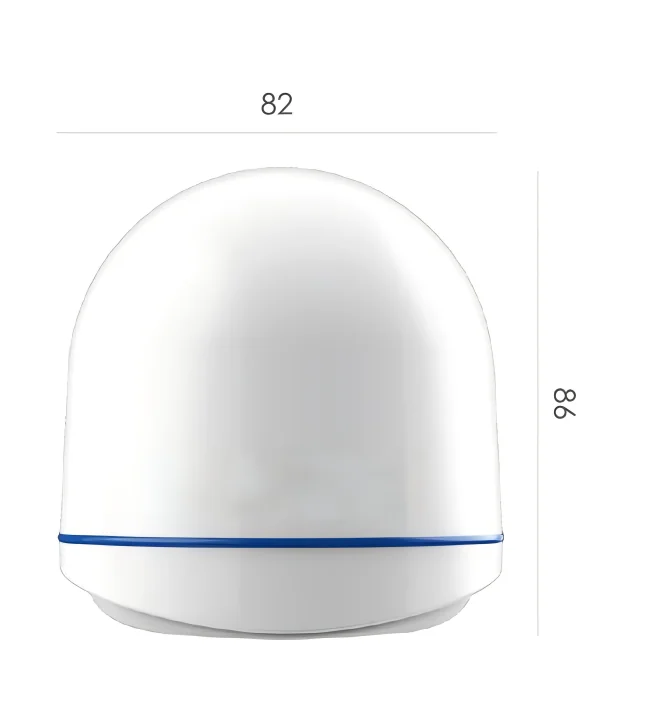
The ladder, in kilograms
The catalogue quotes each model by radome diameter, and it is easy to read that as a simple performance ladder: 33, 45, 60, 75 cm on the V Series; 64, 85, 105 cm on the X Series. The weight column is the part that changes the installation.
| Model | Radome | Weight | Minimum EIRP |
|---|---|---|---|
| V3 | 33 cm | 5 kg | 50 dBW |
| V4 | 45 cm | 12 kg | 48 dBW |
| V6 | 60 cm | 20 kg | 46 / 47 dBW |
| V7 | 75 cm | 32 kg | 44 dBW |
| X6 | 64 cm | 37 kg | 46 dBW |
| X8 | 85 cm | 80 kg | 43 dBW |
| X10 | 105 cm | 125 kg | 41 dBW |
Between the smallest and largest V model the weight ratio is over six to one. Between a V7 and an X10 it is nearly four to one, and that is before the lever arm of a taller radome on a mast is taken into account.
Why height matters more than weight
A mast is a cantilever. What it feels is not the mass but the moment, and the moment is mass times the distance from the deck — doubled when the vessel rolls, because the load is dynamic. A 32 kg radome on a 2 m mast is a different structure from a 125 kg radome on the same mast, and neither is the same as the same dish on a hardtop where the load path is short and wide.
This is why the honest answer to "can I fit the bigger one?" is a structural question rather than an equipment one. The drawing in the catalogue gives the overall dimensions and the base flange; the mounting steel and the load path belong to the naval architect.
The footprint, drawn the right way round
The reason to go up a model is minimum EIRP, and it moves in the opposite direction from what most buyers expect: a lower number is better. A V7 needs 44 dBW, an X10 needs 41 dBW. Three dB is roughly a doubling of received power, which on a footprint contour map is the difference between sitting inside the coverage and sitting on the edge of it.
So the sizing question is not "how big can I fit" but "what is the weakest contour on my route, minus margin". Answer that first, and the model usually falls out one or two steps smaller than the one the buyer had in mind.
A practical sequence
- 01List the satellites actually watched on the route, not just the one at the home port.
- 02Find the weakest contour the vessel sits inside, and subtract 3 dB for rain and pointing.
- 03Pick the smallest model whose minimum EIRP is below that figure.
- 04Only then check that the mast or hardtop can carry it — and if not, decide whether the route or the structure changes.
Reversing steps 3 and 4 is how vessels end up with a large dish on a structure that flexes, which is worse than a smaller dish on a stiff one: a moving platform on a moving mount cannot track anything.
Related hardware
More engineering notes