CATV or IPTV On Board: Choosing the Distribution Layer for Crew and Cabins
The antenna gets the satellite. The distribution layer decides whether anyone can watch it — and whether you can ever add VOD, CCTV channels or per-cabin menus.
- Author
- TVROVSAT Marine Engineering
- Date
- Read
- 6 min
The chain, in order
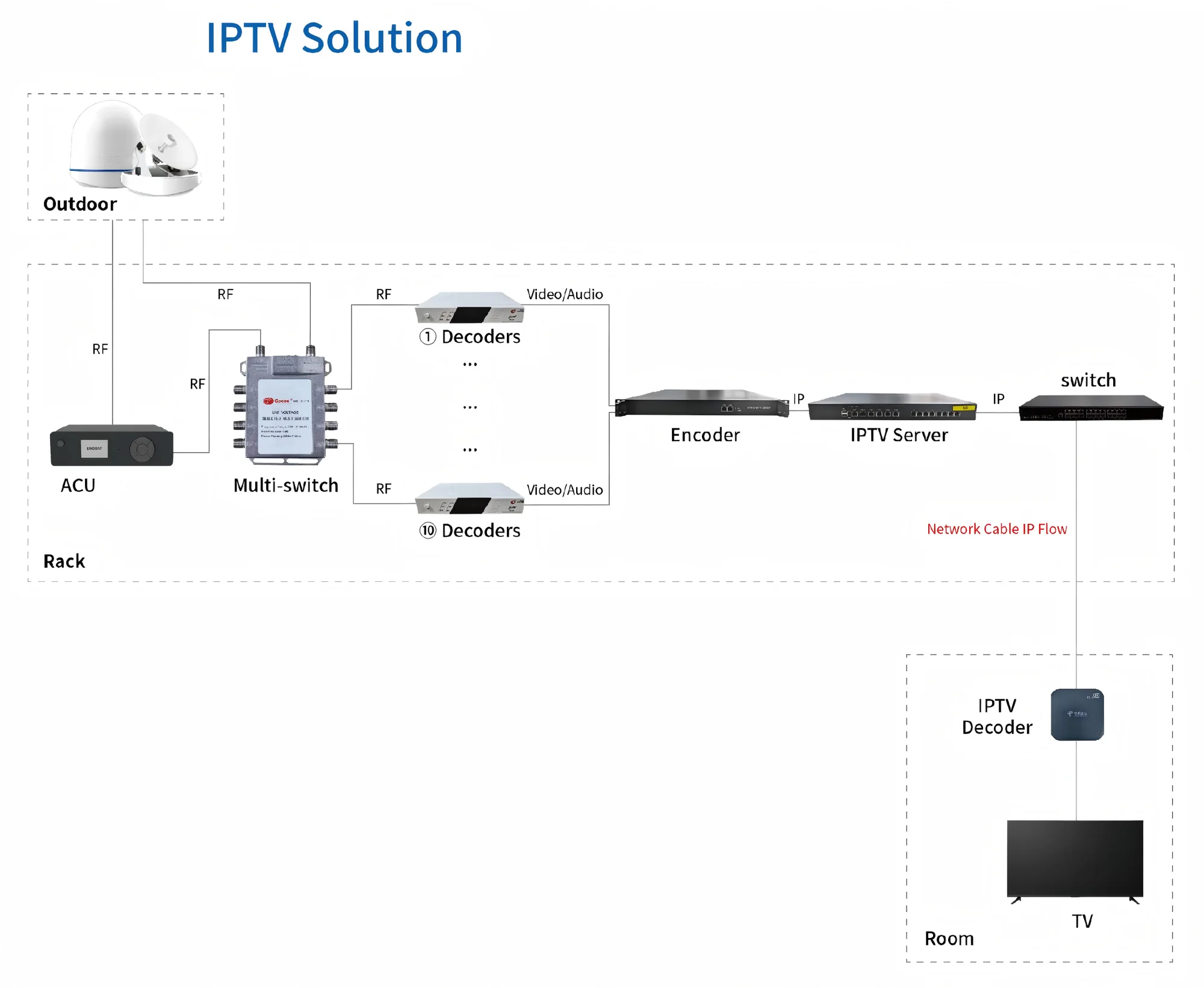
A working TVRO system on a ship is: antenna → ACU → receiver → distribution. The antenna tracks; the ACU powers and controls; the receiver demodulates one transponder; everything after that is distribution, and it is where most retrofits get stuck.
Two routes exist, and they fail in different ways.
CATV: demodulate, modulate, coax
CATV takes the satellite feed, decodes it, and re-modulates it onto the vessel coax so ordinary televisions can tune it. It is cheap, it rides on cable that already exists, and any competent AV installer can extend it.
In the documented multi-room configuration the system reaches up to 58 channels, with the left and right polarization each carrying a different channel set so services do not interfere. That is a real advantage over a naive split: you are not sharing one transponder's worth of content across every cabin.
The limits are structural. Adding a source means adding a modulator. Per-cabin menus, catch-up and VOD do not exist in this architecture. And once the coax tree is full, capacity is full.
IPTV: encode once, stream everywhere
IPTV takes every source — satellite TV, CCTV, video-on-demand, in-house programming — encodes and stores it, and serves it as a digital stream over the ship LAN. The documented feature set includes menu customization, user management, a dynamic boot screen, information insertion and catch-up playback.
This is the route to take when the vessel is a passenger space, not just a crew mess. A ferry that wants a welcome screen with the ship's name, a safety channel next to the news, and a catch-up folder for the overnight watch is describing an IPTV headend, not a coax tree.
The cost is that IPTV depends on a working network. If the ship LAN is fragile, the TV is fragile — the headend is only as good as the switch it sits behind.
Choosing between them
| Question | CATV | IPTV |
|---|---|---|
| Existing coax to reuse? | Yes, cheap | Needs LAN |
| Cabin count | Small to medium | Any |
| VOD / catch-up | No | Yes |
| CCTV as a channel | Separate modulator | Native |
| Per-cabin menu / branding | No | Yes |
| Failure profile | Loses one channel | Loses all channels |
A useful compromise on mid-size vessels: CATV for the crew mess and public spaces, IPTV for passenger cabins. Both can be fed from the same receiver and multiswitch, so the split costs less than it sounds.
Size the antenna and the headend together
It is common to over-specify the antenna and under-specify the headend, and the result is a ship with excellent signal margin and two channels. Decide the channel plan first, then the distribution layer, then the antenna aperture that footprint and route demand. Our sizing note on minimum EIRP covers that last step.
Related hardware
More engineering notes