2-Axis vs 3-Axis Maritime Antennas: Which Does Your Vessel Actually Need?
The third axis is not a marketing upgrade. It changes what the antenna holds when the hull heels and yaws together — and whether your route needs it.
- Author
- TVROVSAT Marine Engineering
- Date
- Read
- 6 min
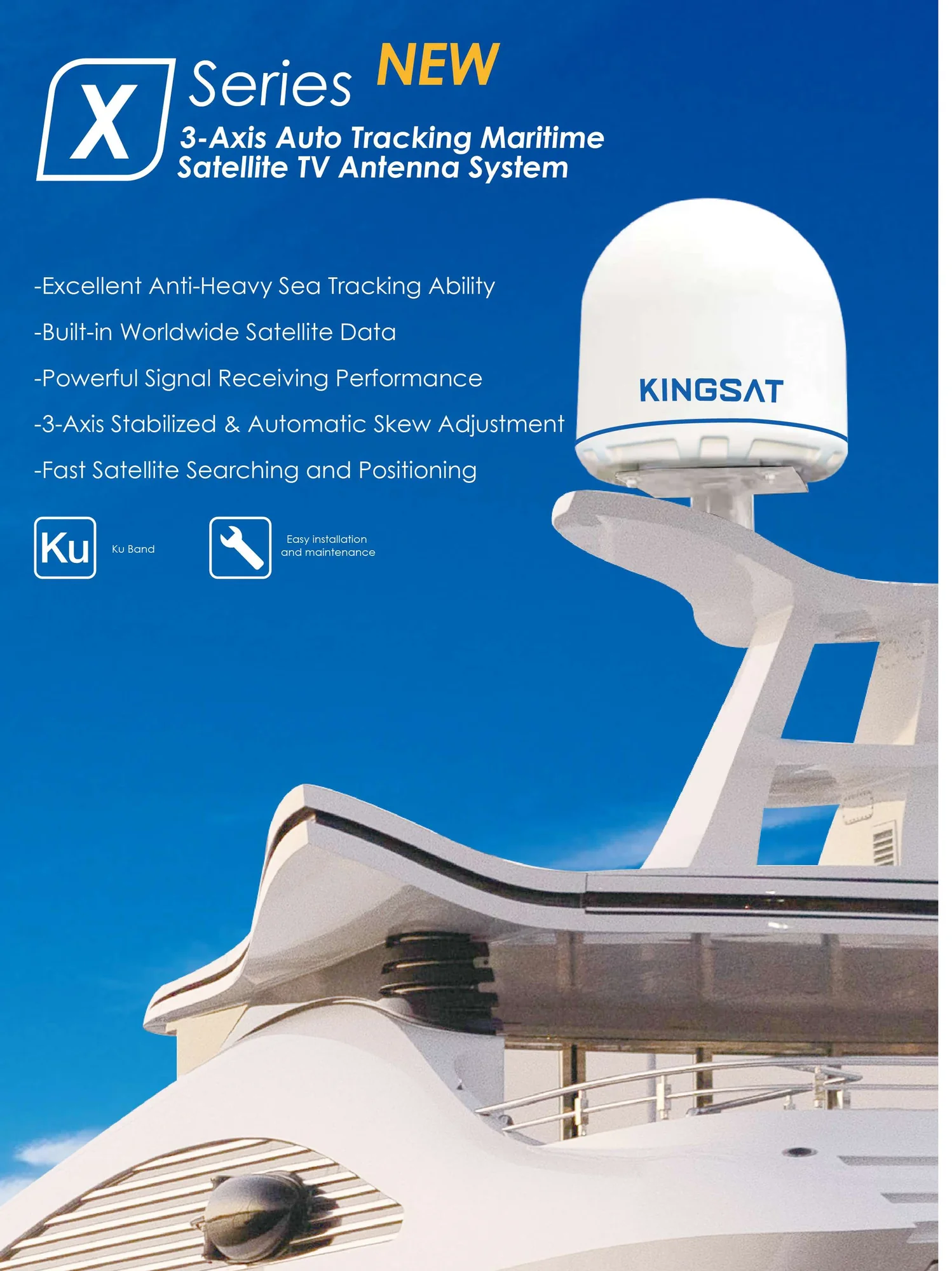
What each axis does
A stabilized maritime antenna has to counteract three rotations of the hull: roll, pitch and yaw. A 2-axis platform corrects azimuth and elevation, which is enough to keep the dish pointed at the satellite through ordinary roll and pitch. A 3-axis platform adds a third rotation — plus automatic skew — which keeps the polarization and the antenna geometry correct as the vessel yaws slowly and heels.
The practical difference shows up in two places: how the antenna behaves in a following or quartering sea, where yaw is slow and large, and how it behaves on a heel-heavy hull where cross-level angle changes faster than a 2-axis mount can compensate.
The documented envelope is the same — the geometry is not
Both our V Series and X Series are specified for roll ±25°, pitch ±15° and yaw ±8° at a 6-second period with a tracking rate above 90°/s. That looks like the same capability, and in calm water it effectively is.
The X Series adds elevation from −5° to 115° and a cross-level range of ±35°. The negative elevation range matters on low-mounted antennas looking at a satellite near the horizon; the ±35° cross-level range is what covers a sailing yacht or an expedition vessel sitting on its ear for long stretches. A 2-axis mount does not have a cross-level range to quote — it recovers the error by moving azimuth and elevation instead, which costs signal during the manoeuvre.
Three questions that decide it
1. How long is the passage? Coastal hops of a few hours tolerate brief drop-outs. Multi-day ocean passages do not — the crew notices every one.
2. How does the hull behave? A displacement workboat in a quartering sea yaws slowly; a sailing yacht heels constantly; a fast ferry produces short, sharp motion. Slow, large yaw and sustained heel are the cases that push you to three axes.
3. Does the vessel change region? A boat that stays on one satellite can be re-pointed once. A vessel that crosses regions needs an antenna whose platform can re-acquire cleanly and a controller that can store and switch configurations — which is where the Advanced ACU earns its place.
A rule of thumb
If the vessel is under about 20 metres, works coastal routes and holds one footprint, the V Series is the economic answer. If it makes ocean passages, heels for long periods, or carries passengers whose experience depends on the TV staying up, specify the X Series and put the engineering into the mounting instead of the spares kit.
Do not forget the mounting
A 125 kg X10 needs a load path into the hull — not a hardtop bracket that was designed for a radar dome. The dimension drawings in our product pages give the footprint; plan the reinforcement with whoever signs off the structure.
Related hardware
More engineering notes