Microwave or VSAT: The Cost Structure Behind the Choice
One has capital cost and no airtime; the other has airtime and no line-of-sight need. The comparison is about where the vessel works, not price.
- Author
- TVROVSAT Marine Engineering
- Date
- Read
- 6 min
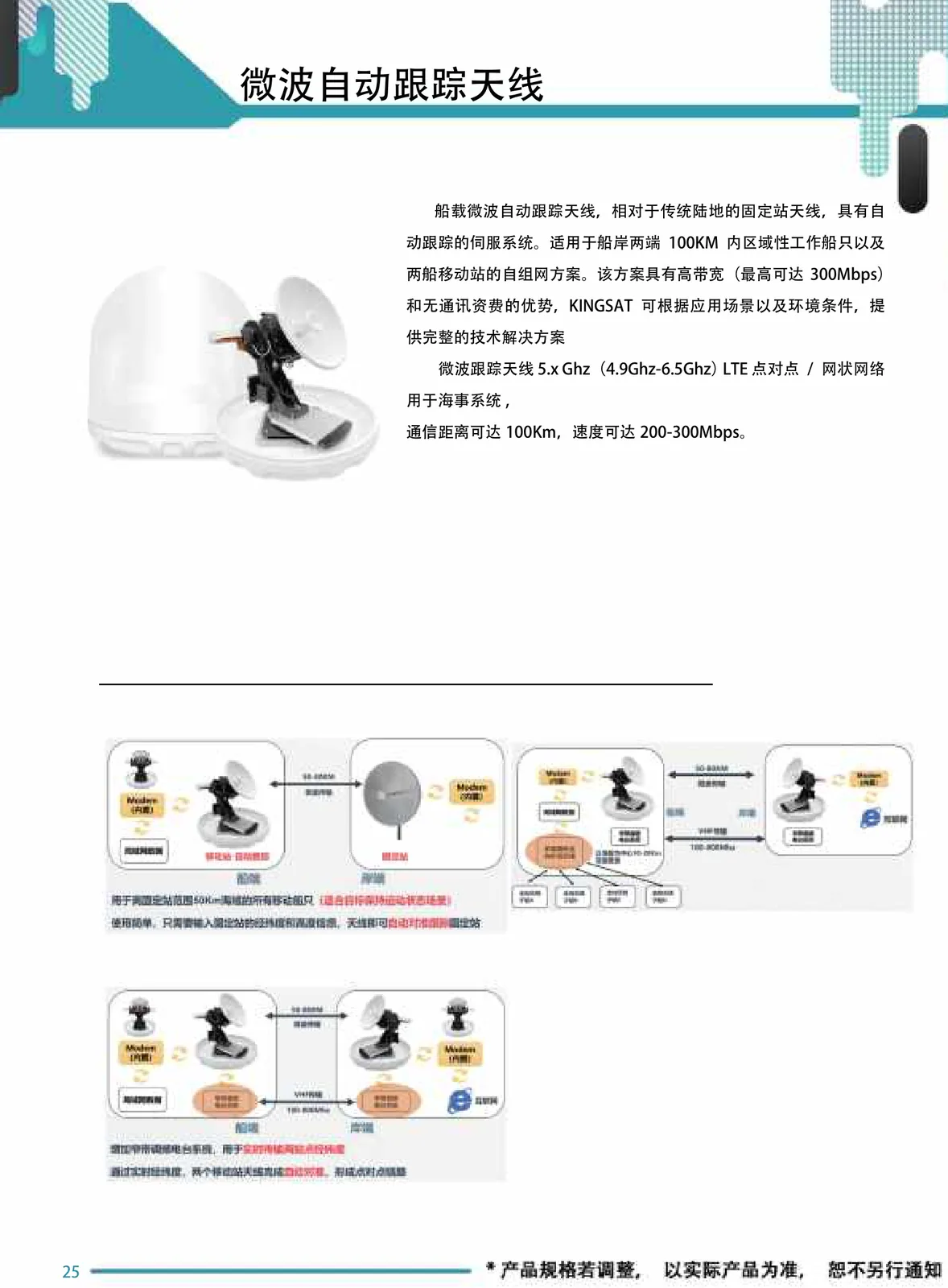
Two different shapes of cost
A microwave link is mostly capital: a shore station, a tracking unit on the vessel, and no recurring bandwidth charge. A VSAT terminal is mostly service: the hardware is modest next to the airtime contract that follows it for as long as the vessel sails.
That difference explains why the same vessel can justify either one depending on how it is used. A vessel that works a fixed field for years amortises the shore station quickly. A vessel that trades worldwide cannot use a microwave link at all, so the comparison never starts.
What the documented microwave link provides
Up to 100 km between ship and shore, 200–300 Mbps depending on configuration, LTE point-to-point and mesh topologies, and an auto-tracking servo on the vessel so the link follows the far end instead of relying on a fixed alignment. No satellite segment means low latency and no airtime.
The constraint is geometric and physical: line of sight, range, and a shore station that somebody has to own and license. Rain fade at 5.x GHz is far less punishing than at Ka, which is one reason the band is popular for coastal work.
Where VSAT is the only answer
Beyond the microwave path, and beyond roughly 35 nautical miles of cellular coverage, satellite is the only link that follows the vessel. The terminal is stabilized on the move, all three bands are listed, and the service set covers internet, voice, video and remote assistance — but every month of that service is a line item.
For a fleet, the interesting comparison is not microwave versus VSAT but how much traffic can be moved onto the cheap link. A documented priority-switching arrangement between cellular and satellite does exactly that for coastal operation.
The questions that actually decide it
- 01Does the vessel have line of sight to a shore point it will stay within 100 km of?
- 02Can that shore point host a station — power, mast, licence?
- 03What throughput is needed, and is 200–300 Mbps a ceiling or an over-specification?
- 04What is the annual airtime spend, and how many years would it take to pay for the shore station?
If question 1 is "no", the rest is noise. If it is "yes" and question 4 has a short answer, the microwave link is the cheaper system over the life of the vessel — and the satellite terminal becomes the redundancy rather than the backbone.
Related hardware
More engineering notes